Showing posts with label government sponsored entities. Show all posts

Monday, July 23, 2018

Government Sponsored Economic Crises


I was talking to a customer the other day and he brought up a subject that I suspected was happening, but don’t want to believe: We are in another housing bubble. 


I hope he’s wrong, but all the signs are there. We all remember the last one. Many businesses and families were destroyed because of that federal government created disaster. Why do I say that? Because that crisis couldn't have happened without government sponsored entities such as Fannie Mae and Freddie Mac and all the Clinton cronies who ran those two organizations.


As a student of history, I can’t help but notice that most economic calamities that befall our country have been induced by the federal government. For instance, let’s take the Panic of 1873. Jay Cooke became the richest man in the country due to his financial dealings with the federal government, that was until his empire crashed bringing about one of the worst depressions in American history. Here is an excerpt from Murray N. Rothbard’s, The Progressive Era:


The railroad financier with the closest ties to the Republican administration was the redoubtable banker, Jay Cooke, head of Jay Cooke & Co. A small Philadelphia financier at the outset of the Civil War, Cooke had the vision to found his banking house and to wangle from the federal government a monopoly on underwriting the massive bond issues floated during the war. To sell them to the gullible public, Cooke launched the first modern propaganda campaign for selling the bonds, employing thousands of subagents and such slogans for the credulous as “A national debt a national blessing.”


Cooke obtained the highly lucrative monopoly underwriting concessions from Washington through his influence on Secretary of Treasury Salmon P. Chase. Cooke’s brother, Henry, was a long-time aide of Chase, from the latter’s tenure of Governor of Ohio,. Henry then followed Chase to WAshington. After extensive wining and dining of Chase, and after demonstrating his propaganda methods in selling government bonds, Jay Cooke won the coveted concession that was to make him one of the richest men in America and his new Jay Cooke & Co. by far the leading investment bank. Cooke became widely known as “The Tycoon,” and the phrase “as rich as Jay Cooke” became a popular saying.
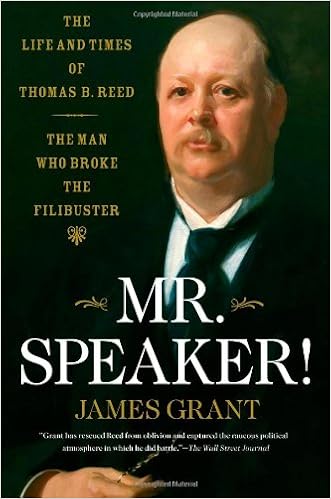

Image result for mr. speaker james grant


One of the casualties of the Panic of 1873 was the Freedman’s Bank. This institution’s clientele consisted of ex-slaves, mainly veterans of the Union army, who entrusted their life savings to a bank they thought was backed by the federal government. Boy were they wrong, especially after Henry Cooke got his mitts on it. Here is an excerpt from Mr. Speaker by James Grant:


In 1870, they amended the charter to permit a more liberal policy. No more was the management restricted to buying dull government bonds but could now roll the dice in real estate. Up, therefore, went a splendid new headquarters building for the bank on Pennsylvania Avenue. It was in this same year that the board fell under the spell of Henry D. Cooke brother of the era’s most bedazzling financier, Jay Cooke. Under Cooke’s leadership, the Freedman’s Bank finance committee took to calling the reserve fund “idle money.” Why bother with a rainy-day fund when the sun shone bright?


What extent Henry Cooke played into the demise of this institution is debatable. The Freedman’s Bank was rife with mismanagement and outright fraud; it wouldn’t have survived either way. But the underlying belief was this bank was guaranteed by the federal government and many a petition was filed decades after and all for naught. The federal government paid not one penny to a depositor.


One of the biggest shoes yet to drop is our national debt. When this federal government behemoth befalls our country, it will put all other depressions to shame. And this couldn’t have happened without the Federal Reserve (another government sponsored entity) and the greenback. Here is another excerpt from Mr. Speaker! By James Grant:


The Greenback furor is calculated to mystify most patrons of a 21st century automatic teller machine, for whom paper money is the only money they know. Not since 1971 has the dollar been remotely backed by gold, and not since 1933 has an American citizen been able to exchange paper for gold, or gold for paper, at a fixed, statutory rate. From the millennial vantage point, therefore, the paper dollar is the modern contrivance, the gold dollar the anachronism. Not so, however, in the late 1870’s. At the time, gold was the money of the future, as it had been in the past. As Reed was finishing his first congressional term and beginning his second, the gold standard was being institutionalized in Europe. Silver, now much the cheaper of the two precious metals, was the money of Mexico, China, India and other such poor and forlorn lands. Paper, held the enemies of Solon Chase, was the money of communism and anarchy.


Image result for bernie sanders and alexandria


Without fiat money, communists like Bernie Sanders and his acolytes wouldn’t have a platform to stand on. And when this whole house of cards falls around us the anarchists will have their day.


Source:

Monday, July 29, 2013

Sen. Kay Hagan Wants to Replace Fannie and Freddie with Another Government Agency


When I read that Senator Kay Hagan wanted to rid the country of GSE’s Fannie Mae and Freddie Mac, I couldn’t believe it.  A Democrat wants to abolish a quasi-government agency?  This is practically unheard of.  Here is a quote from the Charlotte Business Journal:

“For too long, Congress has ignored our broken housing finance system,” Hagan said in a statement Tuesday. “It is time we come together, Democrats and Republicans, to resolve this problem. This bipartisan bill provides an important road map for strengthening our housing finance system and protecting taxpayers while ensuring access to affordable, long-term mortgages for consumers.

“I look forward to working with my colleagues to advance this bipartisan legislation that will put our housing finance system on a stable path.”

And

“Fannie Mae and Freddie Mac continue to dominate the housing market — guaranteeing nine out of every 10 mortgages made today,” Hagan's office says in a press release. “Despite this unsustainable situation, real reform to the housing finance has not happened since the financial crisis.”

Incredible!  Finally, Senator Kay Hagan has opened her eyes and sees the light.  But then came the caveat:

The bill would replace Fannie and Freddie with a new government agency, funded by the financial industry, that would offer insurance on approved home loans.

Currently, Fannie and Freddie are in government conservatorship after they faltered in the housing collapse of 2008. They have received more than $188 billion in taxpayer aid, which is being repaid from profits as the housing market rebounds.

So Senator Hagan wants to create another government agency that will end up being corrupted just like Fannie Mae and Freddie Mac.  Unbelievable!  Something must be in the D.C. water.


Thursday, October 6, 2011

The Export/Import Bank of the United States is the Godfather of New Deal Crony Capitalism

The Department of Energy has become the poster child of crony capitalism. But there is another agency operating under the radar, that’s been around since the New Deal era with a track record just as bad. And like its cousin Fannie Mae is quasi-governmental.

President Franklin D. Roosevelt started the Export/Import Bank via executive order in 1933; in 1945 Congress made it an independent agency. And like Fannie Mae, is a government sponsored entity that provides loan guarantees, direct loans, and insurance to those who couldn’t obtain one in the private sector. The purported goal is to assist foreign buyers and countries in the purchase and export of American goods.

The charter for the Export/Import Bank of the United States is subject to periodic renewal by Congress and is purportedly self-sustaining, but the House Appropriations Committee says differently:

Export and Investment Programs – The bill provides $266 million for export assistance programs, a reduction of $84 million from the request. The bill also includes $1.5 million over fiscal year 2011 for the Export-Import Bank Inspector General to provide robust oversight over the agency. The Trade and Development Agency – which promotes U.S. trade interests abroad – is level funded at $50 million, the same as last year

For a better perspective on the banks operations, I refer to Timothy P. Carney of the Washington Examiner:

Ex-Im is a posterboy for corporate welfare. Its mission is to transfer money from U.S. taxpayers, through foreign buyers, and ultimately into the pockets of American companies. While the agency touts its support for small business, a vast majority of its money goes to subsidize sales by the largest corporations in America.

The money from Ex-Im loans and loan guarantees — the agency’s biggest transactions, and the only kinds that are itemized in Ex-Im’s annual report — goes overwhelmingly to a handful of large corporations, including Halliburton, Bechtel, General Electric, Caterpillar and Westinghouse. But there’s a reason Ex-Im is known as "Boeing’s Bank."
In fiscal years 1998 through 2005, Ex-Im has issued $63.5 billion in loans and long-term guarantees. In those years, $33 billion of Ex-Im subsidies went to Boeing. That means that a majority — 52 percent — of Ex-Im’s money went to help just one company.

But that was under previous administrations. The Obama administration is now using the bank to invest in the development of natural resources in foreign countries like Brazil:

The U.S. is going to lend billions of dollars to Brazil's state-owned oil company, Petrobras, to finance exploration of the huge offshore discovery in Brazil's Tupi oil field in the Santos Basin near Rio de Janeiro. Brazil's planning minister confirmed that White House National Security Adviser James Jones met this month with Brazilian officials to talk about the loan.

The U.S. Export-Import Bank tells us it has issued a "preliminary commitment" letter to Petrobras in the amount of $2 billion and has discussed with Brazil the possibility of increasing that amount. Ex-Im Bank says it has not decided whether the money will come in the form of a direct loan or loan guarantees. Either way, this corporate foreign aid may strike some readers as odd, given that the U.S. Treasury seems desperate for cash and Petrobras is one of the largest corporations in the Americas.

It looks like the Obama administration has changed the mission statement of the Export/Import Bank of the United States. And with their track record on loan guarantees, the American people will end up eating this Brazilian “investment” too.


Source: http://washingtonexaminer.com/node/378361#ixzz1a3TwXJin

http://appropriations.house.gov/News/DocumentSingle.aspx?DocumentID=253692

http://www.fas.org/sgp/crs/misc/R41829.pdf

http://online.wsj.com/article/SB10001424052970203863204574346610120524166.html