Showing posts with label housing bubble. Show all posts

Monday, July 23, 2018

Government Sponsored Economic Crises


I was talking to a customer the other day and he brought up a subject that I suspected was happening, but don’t want to believe: We are in another housing bubble. 


I hope he’s wrong, but all the signs are there. We all remember the last one. Many businesses and families were destroyed because of that federal government created disaster. Why do I say that? Because that crisis couldn't have happened without government sponsored entities such as Fannie Mae and Freddie Mac and all the Clinton cronies who ran those two organizations.


As a student of history, I can’t help but notice that most economic calamities that befall our country have been induced by the federal government. For instance, let’s take the Panic of 1873. Jay Cooke became the richest man in the country due to his financial dealings with the federal government, that was until his empire crashed bringing about one of the worst depressions in American history. Here is an excerpt from Murray N. Rothbard’s, The Progressive Era:


The railroad financier with the closest ties to the Republican administration was the redoubtable banker, Jay Cooke, head of Jay Cooke & Co. A small Philadelphia financier at the outset of the Civil War, Cooke had the vision to found his banking house and to wangle from the federal government a monopoly on underwriting the massive bond issues floated during the war. To sell them to the gullible public, Cooke launched the first modern propaganda campaign for selling the bonds, employing thousands of subagents and such slogans for the credulous as “A national debt a national blessing.”


Cooke obtained the highly lucrative monopoly underwriting concessions from Washington through his influence on Secretary of Treasury Salmon P. Chase. Cooke’s brother, Henry, was a long-time aide of Chase, from the latter’s tenure of Governor of Ohio,. Henry then followed Chase to WAshington. After extensive wining and dining of Chase, and after demonstrating his propaganda methods in selling government bonds, Jay Cooke won the coveted concession that was to make him one of the richest men in America and his new Jay Cooke & Co. by far the leading investment bank. Cooke became widely known as “The Tycoon,” and the phrase “as rich as Jay Cooke” became a popular saying.
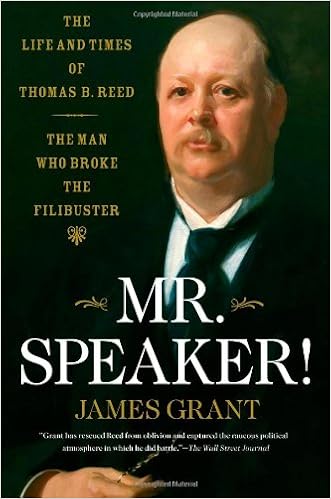

Image result for mr. speaker james grant


One of the casualties of the Panic of 1873 was the Freedman’s Bank. This institution’s clientele consisted of ex-slaves, mainly veterans of the Union army, who entrusted their life savings to a bank they thought was backed by the federal government. Boy were they wrong, especially after Henry Cooke got his mitts on it. Here is an excerpt from Mr. Speaker by James Grant:


In 1870, they amended the charter to permit a more liberal policy. No more was the management restricted to buying dull government bonds but could now roll the dice in real estate. Up, therefore, went a splendid new headquarters building for the bank on Pennsylvania Avenue. It was in this same year that the board fell under the spell of Henry D. Cooke brother of the era’s most bedazzling financier, Jay Cooke. Under Cooke’s leadership, the Freedman’s Bank finance committee took to calling the reserve fund “idle money.” Why bother with a rainy-day fund when the sun shone bright?


What extent Henry Cooke played into the demise of this institution is debatable. The Freedman’s Bank was rife with mismanagement and outright fraud; it wouldn’t have survived either way. But the underlying belief was this bank was guaranteed by the federal government and many a petition was filed decades after and all for naught. The federal government paid not one penny to a depositor.


One of the biggest shoes yet to drop is our national debt. When this federal government behemoth befalls our country, it will put all other depressions to shame. And this couldn’t have happened without the Federal Reserve (another government sponsored entity) and the greenback. Here is another excerpt from Mr. Speaker! By James Grant:


The Greenback furor is calculated to mystify most patrons of a 21st century automatic teller machine, for whom paper money is the only money they know. Not since 1971 has the dollar been remotely backed by gold, and not since 1933 has an American citizen been able to exchange paper for gold, or gold for paper, at a fixed, statutory rate. From the millennial vantage point, therefore, the paper dollar is the modern contrivance, the gold dollar the anachronism. Not so, however, in the late 1870’s. At the time, gold was the money of the future, as it had been in the past. As Reed was finishing his first congressional term and beginning his second, the gold standard was being institutionalized in Europe. Silver, now much the cheaper of the two precious metals, was the money of Mexico, China, India and other such poor and forlorn lands. Paper, held the enemies of Solon Chase, was the money of communism and anarchy.


Image result for bernie sanders and alexandria


Without fiat money, communists like Bernie Sanders and his acolytes wouldn’t have a platform to stand on. And when this whole house of cards falls around us the anarchists will have their day.


Source:

Saturday, June 27, 2015

Bad Economic Policies Weaken a Nation's Foundation


I have to laugh when liberals blame the 2008 economic collapse on the Bush administration.  They would have us believe a systemic collapse could be caused by one man’s policies within his tenure as president.  Hell, formulating an economic policy takes about half a term and implementing it the remainder.  The consequences of that policy don’t show up until years later.

I blame President George W. Bush for many things, but the housing bubble isn’t one of them.  He, like many others, tried to warn the American people, but Democrats dismissed critics as racist.  Look what happened.

No, it takes years for an economic collapse of that magnitude to transpire.  Carolina Journal discusses ‘emergency room economics’ with Dr. Peter Boettke, university professor of economics and philosophy at George Mason University.  Here is an excerpt:

Kokai: You mentioned Dodd-Frank, which would give people some example of some of these unintended consequences. I imagine that just as difficult, or even more, though, are these policies that have long-run, negative economic consequences that you really can’t point to.


Boettke: Yeah.


Kokai: I mean, we’re dealing now with bad policies that were made 30 or 40 years ago that are stunting our economy, but how can you point to them? Because it’s hard to say what caused the economic doldrums we’ve had now. 


Boettke: Well … that’s right. I mean, Frank Knight, the great Chicago economist, once said the problem with economics is we don’t have the equivalent of a wrecking ball, right? So if I wanted to demonstrate the negative consequences of smashing a wrecking ball into a building, all you have to do is watch it, and it happens right away. The problem in economics is that the policy — the wrecking ball — hits the building and then the building crumbles 10 years later. What happens is the wrecking ball weakens this foundation and weakens that, and then the consequences are fully seen 10 years [later], but there’s a lot of things in between.
 

So how do I know that it was the wrecking ball that caused it? Minimum wages are a classic example of that. Rent controls — another classic example, where push a rent control and then 20 years later, you have a decline in the quality of the housing that’s there because people haven’t made the investments and whatnot.
 

I think in our current situation, what we have to look at, for example, one shining thing is the changing role of the Fed [Federal Reserve]. So the Fed has deviated considerably from its original intent and, as well, from the rule of law, over this period of time. What are the long-run consequences for the quality of the Fed to be able to do sound money? Can we actually get a sound monetary policy? It’s unclear that we can, so maybe actually something like an auditing of the Fed is called for right now because we actually don’t know all of the things that are on the Fed and, let alone, on the Fed’s balance sheets. And we should actually have that. 


Normally, I might be against completely an idea of an auditing of the Fed because that would really politicize monetary policy, which in theory, it’s not supposed to do. But we’ve politicized monetary policy, and so now, calling for a public auditing of the Fed actually might be a very valuable policy for us.


Source:

Saturday, June 20, 2015

Market Tremors Portend "Systemic Event"


If you listen real carefully, you can hear rumblings from concerned market watchers and investors.  This is reminiscent of the years leading up to the 2008 housing bubble implosion.  Here is a warning from one investment banker as reported by the Telegraph:


Ian Spreadbury, who invests more than £4bn of investors’ money across a handful of bond funds for Fidelity, including the flagship Moneybuilder Income fund, is concerned that a “systemic event” could rock markets, possibly similar in magnitude to the financial crisis of 2008, which began in Britain with a run on Northern Rock.


“Systemic risk is in the system and as an investor you have to be aware of that,” he told Telegraph Money.


The best strategy to deal with this, he said, was for investors to spread their money widely into different assets, including gold and silver, as well as cash in savings accounts. But he went further, suggesting it was wise to hold some “physical cash”, an unusual suggestion from a mainstream fund manager.


His concern is that global debt – particularly mortgage debt – has been pumped up to record levels, made possible by exceptionally low interest rates that could soon end, and he is unsure how well banks could cope with the shocks that may await.


The housing market crisis is not over.  The bailout of banks and their accomplices was just a band-aide.  The next crisis will make 2008 look like a tremor.

Source:

Thursday, October 24, 2013

Bank of America Takes Fall for Fannie Mae and Freddie Mac


If Obamacare isn’t enough of a demonstration of the incompetence of the federal government, we have Fannie Mae and Freddie Mac stepping up to the plate once again.  These corrupt organizations have sued Bank of America for fraud and have won.  This is theater of the absurd.
 
Must we remind everyone that it was Democratic operatives who ran these government sponsored entities.  It was scoundrels like James Johnson who brokered deals with Countrywide that brought about this whole housing crisis.  Here is a quote from the book Reckless Endangerment that sums up the relationship between Fannie Mae and Countrywide:

It was no coincidence that Countrywide’s operations were so intertwined with Fannie Mae’s and so similar.  Both companies had the same goals to achieve and the same enemies to defeat.  And for years, Mozilo’s friendship with Johnson had given him a front-row seat for the Fannie Mae way – the deep political focus, the co-opting of regulators, the manipulation of public opinion, and extensive granting of to friends and potential foes.

It’s tragic enough that players like Angelo Mozilo and James Johnson, the two players who almost destroyed the U.S. economy, was able to walk away scot free, now Bank of America has to pay the price for Fannie Mae and Countrywide’s sins. And let’s not forget the accusations that the Federal Reserve and Treasury Department threatened then CEO Ken Lewis if he didn’t make the deal.

But hey, let’s have the government takeover our health care system.  What could possibly go wrong?


Source:


Wednesday, January 2, 2013

Study Proves Democrats Destroyed the Economy


Here’s a study you won’t find in the op-ed section of your local liberal rag.  You can be damn sure of that. 
 A new study from the widely respected National Bureau of Economic Research released this week has confirmed beyond question that the left's race-baiting attacks on the housing market (the Community Reinvestment Act--enacted under Carter, made shockingly more aggressive under Clinton) is directly responsible for imploding the housing market and destroying the economy.

The study painstakingly sorted through failed home loans that caused the housing market collapse and identified an overwhelming connection between them and CRA mortgages.

Again, let's review:

-President Bush went to Congress repeatedly for years warning them that Fannie Mae and Freddie Mac were going to destroy the economy (17 times in 2008 alone). Democrats continuously ignored him, shut down his proposals along party lines and continued raiding the institutions for campaign contributions on their way down.

But what you will find are reports on how these financial institutions screwed over the “little guy.”  The Charlotte Observer reported a record amount of fines collected by the courts.  Most of it due to the federal government’s manufactured housing bubble.

The U.S. Attorney’s Office in Charlotte and the Western District of North Carolina obtained record collections – more than $5 billion – in civil and criminal actions in 2012.
The $5.05 billion was the fourth highest collection amount among the nation’s 94 U.S. Attorney’s Offices. Much of the money, federal prosecutors said, came from a $25 billion settlement with the nation’s five largest mortgage servicers, including Bank of America and Wells Fargo, to resolve allegations of abuse and fraud in mortgage loan servicing and foreclosures.

The $5 billion in collections represents a huge increase over the 2011 budget year, when the U.S. Attorney’s Office in Charlotte and the Western District of North Carolina collected more than $13.5 million in civil and criminal actions.

The vast majority of the 2012 money – about $5.04 billion – was collected in civil actions. More than $11.3 million was collected in criminal and civil forfeitures and more than $4.4 million was collected in criminal actions.
Nearly $6.4 million was paid to the federal court for distribution to victims of crimes, including individuals, companies and government agencies.

Could those government agencies include Fannie Mae and Freddie Mac?  Because the Democrats would have us believe they were the biggest victim of all.


http://www.examiner.com/article/new-study-confirms-economy-was-destroyed-by-democrat-policies

Monday, June 11, 2012

Americans Lose 40% of Their Wealth in Recession

What do you get, when you cross loose monetary policy from the Federal Reserve with government sanctioned success? A big ass bubble! And that’s exactly what happened to us in 2008. The cards came crashing down, and all the players responsible blamed everyone but themselves for this disaster. Here is a report from one of the instigators of our economic crisis, as reported by the Washington Post:

The recent recession wiped out nearly two decades of Americans’ wealth, according to government data released Monday, with ­middle-class families bearing the brunt of the decline.

The
Federal Reserve said the median net worth of families plunged by 39 percent in just three years, from $126,400 in 2007 to $77,300 in 2010. That puts Americans roughly on par with where they were in 1992.

The data represent one of the most detailed looks at how
the economic downturn altered the landscape of family finance. Over a span of three years, Americans watched progress that took almost a generation to accumulate evaporate. The promise of retirement built on the inevitable rise of the stock market proved illusory for most. Homeownership, once heralded as a pathway to wealth, became an albatross.

Americans are back to 1992 status? That’s weird. Wasn’t it in 1993, when Bill Clinton and the Democrats started their housing initiatives? Isn’t that around the time James Johnson of Fannie Mae fame began his schemes with that G.S.E.? Could this just be a coincidence?


Friday, September 2, 2011

Federal Government Sues Banks for Mortgage Fraud

The Federal government is trying to recoup the losses that were incurred by the two government sponsored entities that ran hog wild over the past couple of decades. Fannie Mae and Freddie Mac have incurred billions of dollars in toxic assets; assets that the taxpayers have to eat because of an implicit understanding that the federal government guaranteed these fraudulent loans.

A U.S. regulator filed lawsuits Friday against 17 of the nation's largest banks over losses from mortgage-backed securities, aiming to recoup billion of dollars stemming from the failed investments.

The Federal Housing Finance Agency, the federal regulator for Fannie Mae and Freddie Mac, is
suing some of others for violating federal and state laws in the sale of mortgage-backed securities.

The FHFA alleged that the loans had different and more risky characteristics than the descriptions contained in the marketing and sales materials provided for those securities.

The agency alleged that the banks and mortgage lenders falsely represented that the mortgage loans in the securities complied with guidelines and standards, and they included representations "that significantly overstated the ability of the borrower to repay their mortgage loans."

The total price tag for the securities bought by Fannie and Freddie is $196 billion. The government didn't provide a dollar amount for damages, but it said it wants to have the purchases of the securities canceled, be compensated for lost principal and interest payments, as well as attorney fees and costs.

And while the feds are at it, why don’t they sue the ratings agencies, National Association of Realtors, every congressman who perpetuated this fraud committed by Fannie and Freddie. As a matter of fact, all those executives who served at these two government sponsored entities should be in jail. But their too damn well connected to the politicos who run this country. As a matter of fact, many of these people have served in presidential administrations.

Source: http://www.wnyc.org/blogs/wnyc-news-blog/2011/sep/02/federal-government-sues-banks-over-mortgage-losses/

Thursday, September 1, 2011

Will Maxine Waters Tax OneUnited Bank Out of Business?


If Maxine Waters has anything its chutzpah; she went on a rant about how the banks are shafting the “little people”, and if they don’t start shaking the money tree for the black community, than the big bad banks should be taxed until they go out of business.

Maxine Waters helped cause this financial disaster. Maxine Waters is part of the problem. She helped to spearhead the concept of no down payment loans. Countrywide ran with this concept and look at the mess we’re in because of it. She stood beside Fannie Mae and Freddie Mac when they were under fire by critics and regulators for some of the most creative accounting since Enron. Now, the American taxpayers are on the hook for billions, if not trillions of dollars.

And to top it off, Maxine Waters’s husband held stock and served on a board of a bank that got bailed out by a congressional committee that she served on:

WASHINGTON AND LOS ANGELES — Rep. Maxine Waters, one of Los Angeles' most enduring liberal politicians, has come under scrutiny because of bailout funds that went to a bank in which her husband had owned stock and served on the board.

Waters was a senior member of the congressional committee dealing with the financial crisis when OneUnited Bank -- one of the nation's largest minority-owned institutions -- received $12 million in bailout funds.

Her husband, Sidney Williams, served on the bank board until early last year and held at least $500,000 in investments in the bank in 2007, the most recent year for which public financial disclosure statements are available.

A month before Congress enacted the bailout program, Waters helped set up a meeting between the chief executive of the bank, representatives of other financial institutions and Treasury officials.

"When a member of the financial services committee calls, you pay special attention," said Jeb Mason, who was a high-ranking Treasury official last fall.

He said that the September meeting was billed as a broad discussion by minority-owned banks of the problems they faced but that it ended up a discussion of one bank's problems. He said he only recently learned of Waters' husband's ties to OneUnited and would have liked to have known about them. He added, however, that the connection didn't influence the department.

OneUnited did not receive any federal money at that time, but by mid-December, it had received $12 million in bailout funds.

Waters did not respond to requests for comment.

But she sure as hell will comment on the dealings of others.

Source: http://articles.latimes.com/2009/mar/13/nation/na-maxine-waters13

Monday, August 8, 2011

U. S. Senators Unsheathing Their Knives on S&P


Standard and Poor’s downgrade of the United States credit rating may have just opened a can of worms that they didn’t intend to happen. It is now rumored that the political powers that be in the U.S. Senate are unsheathing their knives and are coming full throttle for the throat of this rating agency.

Moody’s and Fitch are wisely sitting on the sidelines waiting for the inevitable bloodbath. None of these credit ratings agencies are innocent in the housing bubble that burst not only America’s economy, but that of the world.

All three are guilty of killing legislation that would have set a precedent. In 2002, the state of Georgia passed the toughest predatory lending law in the country. Standard and Poor’s helped lead the crusade to squash it. The book Reckless Endangerment describes the actions of S&P:

Standard & Poor’s was the most aggressive of the three agencies, however. And on January 16, 2003, four days after the Georgia Assembly convened, it dropped a bombshell. Because of the state’s new Fair Lending Act, S&P said that it would no longer allow mortgage loans originated in Georgia to be placed in mortgage securities that it rated. Moody’s and Fitch soon followed with similar warnings.

It was a critical blow. S&P’s move meant Georgia lenders would have no access to the securitization money machine; they would either have to keep the loans they made on their own books, or sell them one by one to other institutions. In turn, they made it clear to the public that there would be fewer mortgages funded, dashing the “the dream” of homeownership.

Folks, you’d better get your popcorn and drinks ready; because we are about to witness the cannibalization of all the bastards who’re responsible for the implosion of our economy.

Source: http://www.reuters.com/article/2011/08/08/us-usa-debt-congress-idUSTRE7775UO20110808

Reckless Endangerment How Outsized Ambition, Greed, and Corruption led to Economic Armageddon

Wednesday, March 2, 2011

Senator Harry Reid: Republicans Want to Destroy the Economy and Government


Senator Harry Reid stood before the press exasperated at the Republican's audacity to eliminate programs that are useless and a waste of taxpayer monies. The man from Searchlight, Nevada just couldn’t comprehend why the program HAMP is slated for elimination:


“Why can’t they work on things that help the economy?” Reid asked. “Why do they have to work on things that hurt the economy? Why would they want to eliminate a program like that? Just because it came from the White House? This is hard for me to understand why they’re so fixated on destroying our government and economy.”

Wow! This man is one clueless bastard.

My question is why didn’t you do something to help the economy. As far as destroying the government, you Democrats have done a good job of discrediting yourselves and the federal government as an institution. You have shown yourselves to be completely incompetent and untrustworthy to manage the nation’s affairs.

To address why the Republicans are eliminating this program, I’ll quote Edward Pinto, Fannie Mae’s chief credit officer, who testified before the House Oversight Committee as reported by The Washington Independent:

Among the harsh points he made: HAMP’s program requirements are so arcane that servicers have trouble complying:


The Treasury Department…promised “clear and consistent loan modification guidelines that the entire mortgage industry can use.” There are only two words to describe HAMP’s guidelines: numbing complexity. At last count HAMP had 800 requirements and servicers are expected to certify compliance. With-ever changing regulations, a constant need to re-evaluate past decisions in light of new regulations, and multiple appeals, it is no wonder that the HAMP pipeline became clogged through no substantial fault of servicers.


Ultimately, the program should help just 6 or 8 percent of the initial target of homeowners:


[In previous testimony I noted] that the then-current HAMP pipeline would likely yield only 250,000 homeowners who would ultimately avoid foreclosure under HAMP — only about 6 percent to 8 percent of the original goal. It now looks like my projection will be pretty close to the mark. HAMP activity has slowed markedly, with the number of new monthly trial modifications declining by two-thirds between December 2009 and May, 2010. The number of new permanent modifications in May 2010 was 30 percent below the April 2010 count. As of May 31, there were 340,000 active permanent modifications. Assuming a 40 percent re-default rate, only 200,000 of these permanent modifications will likely be successful over the long-term. There are another 468,000 active trial modifications. Of these, perhaps only 75,000 will become successful long-term permanent modifications. Discounting all the spin, a slowing HAMP pipeline will yield about 275,000 successful long-term permanent modifications, with perhaps another 100,000 successes resulting from future trial modifications. Today, I reiterate my warning about Treasury’s propensity for applying a rosy gloss.


He also said that HAMP has, perversely, ginned up the number of strategic defaults and simply “extended” the length of the market correction:


HAMP’s flawed design and implementation along with Treasury’s early efforts to “shame and blame” the mortgage servicers promoted strategic defaults, as many borrowers came to expect a modification and blamed their servicer for not getting one. HAMP has also slowed down foreclosure processes, pushing the level of heightened foreclosure activity out to 2013 or 2014 and likely extending the period for the market to correction.


All in all, the hearing today has solidified the view that HAMP has largely failed, and in some cases made the housing crisis worse


Source: http://cnsnews.com/news/article/sen-reid-republicans-fixated-destroying

http://washingtonindependent.com/88229/former-fannie-exec-batters-hamp-as-a-failure

Monday, May 10, 2010

Barney Frank Spittles Through the Housing Bubble


The country should make everyone in his district run the gauntlet for electing this jerk into office.